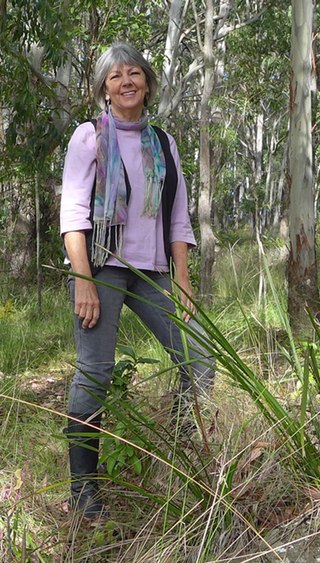
 Sharyn Munro lived for decades in a solar-powered mudbrick cabin on her remote mountain wildlife refuge in the NSW Upper Hunter Valley, the heart of her first two books, The Woman on the Mountain (Exisle 2007) and Mountain Tails (Exisle 2009).
Mother of two, grandmother of five, concern for their future drives Sharyn to use her very personal nonfiction style to reach beyond the converted. In The Woman on the Mountain, sustainability and global warming concerns mix with memoir, nature writing, and survival adventures with chainsaws or snakes. Threatened species is the theme underlying Mountain Tails, a self-illustrated collection of short pieces for animal lovers.
Her short stories have won many prizes, including The Alan Marshall Award; she wrote regularly for The Owner Builder Magazine, and her essays have been published in the Griffith Review and famous reporter.
The very different Rich Land, Wasteland — how coal is killing Australia (Pan Macmillan/Exisle 2012) arose from her empathy with the people and places of the nearby Hunter Valley being devastated from runaway opencut coalmining. The aim of this self-designated ‘commonsense activist’ was to shock Australians into action, with the truth about coal and CSG. People have compared her book to Silent Spring in its passion, its exposure of issues and the possibility it may lead to a change in the way we treat our world.
In late 2014 she moved to a different mountain, closer to family, and with new wildlife to be discovered and chronicled in her blog. After her house was flooded in 2021, she moved to the mid north coast, where once again, she is discovering different Nature and sharing it on her blog.
A few health scares have made her determined to reclaim her path in fiction writing, especially her much loved short stories, and the Peeping through my fingers collection is the first result. As she nears her 75th year, she aims to use her way with words for both storytelling and activism. Our world needs both – to understand life and to save it.
Listen to this illuminating 2016 podcast interview by Natasha Milne with Sharyn about her life, her books and her activism:
Hi Sharyn
Just finished reading your book “Woman on a mountain” – fascinating. I was born in Kenya but moved with family to Cape Town where I grew up. My father in particular although an engineer by profession was deeply into nature conservation and bird photography and all our holidays were spent travelling around game parks in Southern Africa including Mozambique Namibia (then South West Africa) Botswana and Zimbabwe (then Rhodesia). When I went to uni I got involved with the ant iapartheid movement and later when I tried to support myself in work it was just all too difficult (men problems mainly) so I moved to the UK lived in London for 15 years which was a culture shock and then with a help of an old school friend moved to Swansea Wales where I now live in an old draughty housing association house but with a nice view over the Bristol channel and enough periods of relative quiet to make city living not too unbearable. The employment situation in Wales generally is dire and I have joined one of the masses making ends meet on benefits – something I would never have been able to do in South Africa or Australia from what I gather. I want to try to write some kind of book for people on long term unemployment with encouragement of the fact that you still have choices on how to live in a greener way even if on a tight budget, something you yourself have had to cope with. I thought of calling it “Benefit Cooks” as opposed to benefit crooks which is what we are commonly branded. If you have any tips about how to get published or likely publishing houses who would look at this I would be grateful.
I was wondering if you are still living in your mountain cabin?
Kind regards
Sue
Thanks for your comments Claudia. Totally agree with you, and I too fear for our world.
Hi Sharyn,
Never believe anything one does or say to try to save our environment, its flora and fauna for others or influence something or someone is a waste of time. Or writing a book. What is history made of? Stories. Experiences. Governments should take more note of feedback from the average person who experiences, has added expertise, notices or may offer a suggestion, option or solution. Such a valuable wasted resource. People. All this is free of charge. While they waste taxpayer money making poor decisions, that need solutions tomorrow. Job making schemes for the future? Do we ever see any government actually solving something?
We are all in a man made rat wheel, providing jobs, to pay for others jobs, and trying to get 5 minutes of happiness from it.
Now with environment. Has anyone added war and its emissions to our industry induced Climate Change emergency, and called or declared it a war crime on our environment? Those responsible being charged. Thank you Sharyn for your books. I suppose, none of us start off being writers or make comments or add to the discussion until there is a need to say what everyone else is also thinking. We need more like you. And I am sure there are thousands out there, worldwide. There is power, in each one.
I really fear for this planet. We know what is happening above the ground. But what is happening below our feet? Explosions, tested weapons, holes from removal of fossil resources to burn. What is this causing? Is this contributing to more earthquakes or anything else, unseen? This cannot continue. We are at man made, saturation point. The symptoms are here.
Hi Trang Nguyen,
So glad you became really involved in my place and my story. It was a delight to write. I love to hear of my books finding new homes…
Cheers
Sharyn
Just finished the book ‘The woman on the mountain’ that i scored in a hall at the book fair months ago. I haven’t been able to put it down until finally finished this rainy weekend! Thank you for sharing your story, passions, pains and experiences. You are truly a talented woman.
Dear Sharyn
Your book Woman on the Mountain was gifted to me three and half years ago when we purchased 160 acres backing onto national park in SE Queensland. It was not only entertaining, but taught some important lessons regarding bushfires and these lessons I put into practise. Your book was shared with a friend and coincidentally, it was she who was at our land when fire came 13 weeks ago. We lost 159 acres, but the area around the cottage and shed was saved. The rural firefighters praised how we kept our property and made their job easier. Some of that praise needs to go to you Sharyn for passing on your experiences through such a well told autobiography. On Christmas Eve we finally got a good storm and there are specks of green once again on the mountain. I know you must be distressed to see bushfire devastation happening right now, so thought I would share a little bit of good news.
Hi Sharyn,
In the last twelve months I have embarked on the road to expose the fact that Mining companies aren’t responsible corporate citizens as they portray. What you have done with your book I want to do with with video, particularly drone footage that allows us to see the devastation clearly aswell as interviews with people whos lives have been changed forever. While I am not against mining totally, there is viable, sustainable alternatives that helps our economy while at the same time protects our environment much better than the insanity of open cut mining. My first couple of attempts I have posted on youtube. This the link.
https://www.youtube.com/watch?v=da39cskw5q8
I live in the Hunter Valley and I would appreciate meeting up with at you sometime in the near future if possible. I’m sure your wealth of knowledge would be helpful in planning my visual campaign. I am keen to read your book over the coming days.
Kindest regards
Wayne Riley
Hi Claudia,
Thank you for that well-reasoned and impassioned comment.
As I say in my intro, I am not anti-mining per se. It depends on what and where and how.
Yes I have always advocated no exploration licences issued in inappropriate areas, like Gloucester; the long years before approval or not are the most wearing and divisive.
I am not convinced we need to have yet another set of risks for future generations re uranium, but full circle responsibility, dealing with the waste created by any mining process, and with the end result, like final voids from coal (approved!), are certainly what I want!
Best wishes, and keep putting the word out…
Sharyn
Dear Sharyn,
I am an Australian illustrator, for reproduction, since 1971
The majority of my work is published. I would like to share my story with you and your readers. I was given a copy of your fabulous book, on New Year’s Day, 2019, by a neighbour. Purchased, for holiday reading. And to quote said: ‘ If you were not anti mining, before reading this book – you will be NOW, .’ Rich Land, Waste Land, by Sharyn Munro. A perfect non fiction recommended reading for Australian CHILDREN AS PART OF SCHOOL CURICULUM. Mandatory. Bravo.
In it – I found what I have been saying all along: THAT VIABLE FARMING AND AGRICULTURE LAND SHOULD BE EXEMPT FROM EXPLORATION AND MINING. I have passed the title of your book to many since reading it, inclusive of politicians, since that first week of 2019.
Mining renders farming land in my opinion, toxic,
after 20-30years, Why destroy it for a mine?
I am not anti mining, anti nuclear, or uranium. These could work better together, with changes to legislation. Exploration Licences, should not be handed out in my view, anywhere and everywhere in Australia. As an open gate. These large open cut and underground projects, take out great chunks of precious environment, and with them all flora and fauna and endangered species, inclusive of water systems. These never to return. I would be concerned about sinkholes in the future. As layers will eventually subside. Our precious resources shipped overseas to burn. And a moon like surface the result.
The current UN Nature Report of 6th May 2019. With input from Australia, Tells us that habitats are being destroyed, We need to rethink how we use our land, there being deforestation. And loss of our planets resources. We need to conserve. All have a role to play. AND NEED A CAREFUL RESCUE PLAN. As the planet is in its worst environmental state – since, man.
Why is this destruction allowed? Legislation in its present form, in my view, allows it.
I deconstruct projects to illustrate them. And insight is gained not available to others. I sometimes can offer a potential solution. I have worked for Government, Department of Mines and Energy, Fisheries, Conservation and hundreds of other. Communication and Publications. As a freelance illustrator, my work is usually published.
MY SIMPLE SOLUTION TO STATE AND FEDERAL GOVERNMENTS in all countries.
IS TO: MAKE VIABLE FARMING LAND, AGRICULTURE LAND, ENDANGERED and natural ECOSYSTEMS, WATER SYSTEMS, AND SITES OF CULTURAL SIGNIFICANCE AND SACRED SITES and small historical townships and their communities – EXEMPT FROM EXPLORATION AND MINING. FULL STOP- IN ONE STEP.
Just do not hand out exploration licences in these sites. Surely these bodies have had time to make lists of endangered species for these areas inclusive of cultural sites by the year 2019. Would this happen in The Chianti, or The Champagne districts of Europe? Would they allow exploration and then mining under and between the vines, or other agricultural areas. I do not think so.
Where I live, as an example; A mining company is still able to explore, given an exploration license (EL) on some ones viable farm, the farmer then has to fight the company in court. The farmer may then, win. Then the Mining Company, can appeal, and WIN.
I am hoping some changes will come about, with mining Act Amendments, in the future.
The second change I would like to see, through Legislation amendment is TO MAKE MINING PROJECTS, SUSTAINABLE ‘CRADLE TO GRAVE’ OPERATIONS, IN THE CASE OF ANY NEW URANIUM MINES – THESE should NOT in my opinion BE APPROVED WITHOUT AN EXTENSION or retrofit TO INCORPORATE and retake NUCLEAR WASTE. This would save us , the taxpayer from paying to then rehabilitate these mines- as we see now,
This would ensure rehabilitation, jobs into the future, the mine would provide jobs and royalties. AND A SOLUTION TO NUCLEAR WASTE. Nuclear waste facilities, are just uranium mines in reverse, requiring the same approvals of a new mine. Why dig more holes, destroying more environment. Use the holes we already have. Reverse our thinking. Put the crumbs back into the jar, This dilemma did not exist 40 years ago, and as the same in The United States, recently the Administration suspended building new Nuclear Power Stations, pending a solution to Nuclear Waste – they too are looking for a nuclear waste trashcan.
As background, I illustrated an addendum to a proposed Australian Uranium Mine, 1979. The addendum of 10 weeks hand drawing – designed for many audiences, answered the questions likely of this project. The lifespan, Those Affected, and The Rehabilitation after end of project of about 22 years. The joint partners of this project should be commended for the way they holistically answered pictorially all the questions of the project, designed for many audiences. For those that do not know, uranium mines are tailored to the Tailings dam. Once the dam is full, project over. And we all know what happens to these dams if they overstay their welcome. Two come to mind.
I started to write to various bodies, when I noticed the thousands protesting re a Nuclear Waste dump to be built in our beautiful Flinders Ranges South Australia. I knew I had to do something. And wrote the first of many letters.
Years ago, I had written, when this was first proposed – that uranium mines should in my view be ‘cradle to grave’ operations, and designed to be sustainable. To retake, as part of their design and incorporation – nuclear waste. The conditions would be the same as when the mine was approved. And this would mean, the mine would be progressively rehabilitated, extend its life, provide jobs and royalties. And we would not need to dig another hole, to put this waste in, and destroy more environment and habitats. Unfortunately, I found, that they were looking for sites, not necessarily solutions.
I am using this as a test case. If an educated woman cannot do something. What chance is there for anyone else? Thank you Sharyn, for your book. We now know that most Australians believe that environmental damage starts on the ground. And climate change. Basic science, remove all vegetation, no oxygen, eventual death. Ours.
The most difficult is to spread one’s possible solutions about, to those that can implement change. And this is still too slow. These changes should be approved. Today.
Hi Sandy,
Thanks for your interest and for helping spread the word about what is happening!
Cheers
Sharyn
Hi Sharyn, I have been following your articles in Owner-Builder Magazine for a few years now, and I am impressed with the publication of your new book about the horrible coal mining industry. Thank you for collating the facts from around our country and hopefully some more people will become aware of the negative aspects and work towards a sustainable future. I will ask my local community centre to purchase your book as I know many locals would be interested in reading it. I wish you all the best, Sandy.
Hi Robyn,
Thanks for making contact. It gave me hope to meet people newly becoming active like you two! I am glad my books will help inform you.
Thanks for telling me about Adam; we need more good independents.
Cheers
Sharyn
Hello Sharyn,
Many thanks for sharing your knowledge and time at Gloucester recently. We are enjoying your books very much and there was much to learn in all of them.
We are fortunate to have Adam Blakester as an Independent candidate for New England. Adam has a great record of looking after people and the land. His values meld very well with the theme of the Sustainable Gloucester weekend . It is so nice to have hope.
Thank you so much for your care .
Cheers
Robyn
Hi Sam,
Thank you for your comments; couldn’t agree more. Many people have given their local MPs a copy. One shocked reader bought 100 copies of the book and sent to 100 politicians, each with a personal letter, so they ‘would know the harm they do’.
Who knows how many read it?
best wishes,
Sharyn
Professor from Nortodam university given me your book.
I am so shocked we have been digging our own graveyard ourself. Coal is toxic and it destroys ecosystem. Public health. Have you send your book to every Pm and environment Minister of Australia and every Minister
Every company CEO and general public should read your book.
Let’s work together to stop the cause of the illness and environment destruction.
Thank you
Sam
https://pollutionstoppers.org
Thanks Helen. It was a treat to live on the Mountain and I miss it still. I hope to write a sequel to that book as life rolls on with new challenges!
Sharyn
Thanks Helen. It was a treat to live on the Mountain and I miss it still. I hope to write a sequel to that book as life rolls on with new challenges!
A passionate authentic life – I am full of admiration. You did it hard but stuck to your truths. Your honesty and wisdom shine through in The Woman on the mountain. You You are s wonderful writer – don’t know how you wrote when life was such a daily challenge. Hope now you are resting your body. You deserve to. Thanks
Helen
Hi Fitriadi,
Sharing a love of nature and thoughts about things that threaten it comes easily to me. I’m just always grateful that people like you care enough to read what I write!
Cheers
Sharyn
You’re a real deep thinker. Thanks for sharing.
Hi Phil,
It was nice to see you and Annie again. Thanks for the kind comment and thought re donations but not really possible to do that. Yes, travel is an issue when you’re on a pension, but often a group will offer to meet my fuel costs if it’s a fair distance, and I usually get billeted. Luckily I’m a very frugal person!
Dear Sharyn,
I felt honoured to talk with you again after your fabulous moving talk at Gloucester on Saturday! Your stories of community disruption and environmental harm caused by the destructive coal and gas industries deserve to be heard by all Australians, but I know how costly travel is to do so.
Please consider adding a donate button to this website, as I’m sure there are more like me who would be keen to help support the costs your campaigning obviously involves. Please let us contribute to your i work more than just by buying your book! Yours in awe – Phil Bradley (ParraCAN & Parramatta Greens)