Macropods rule again

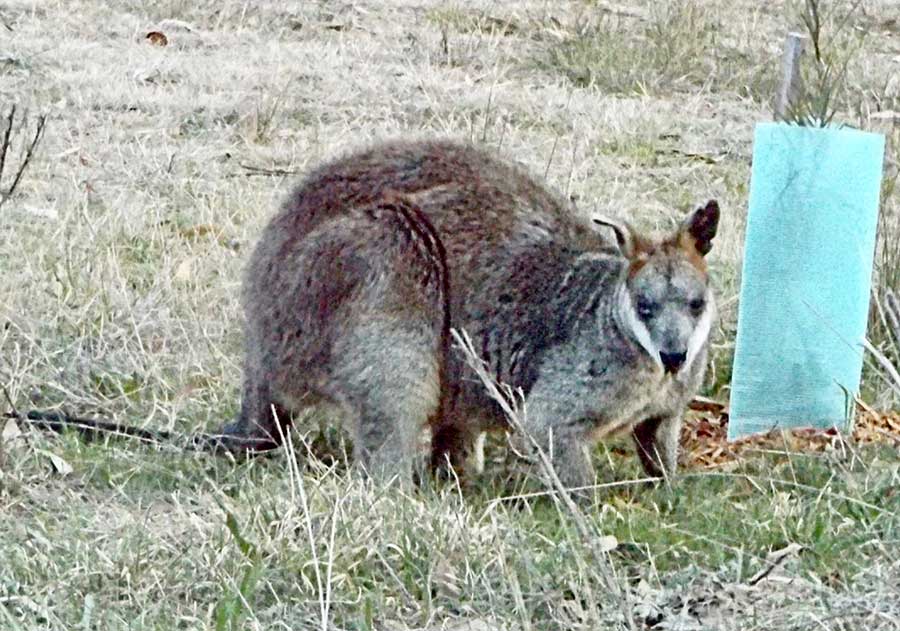
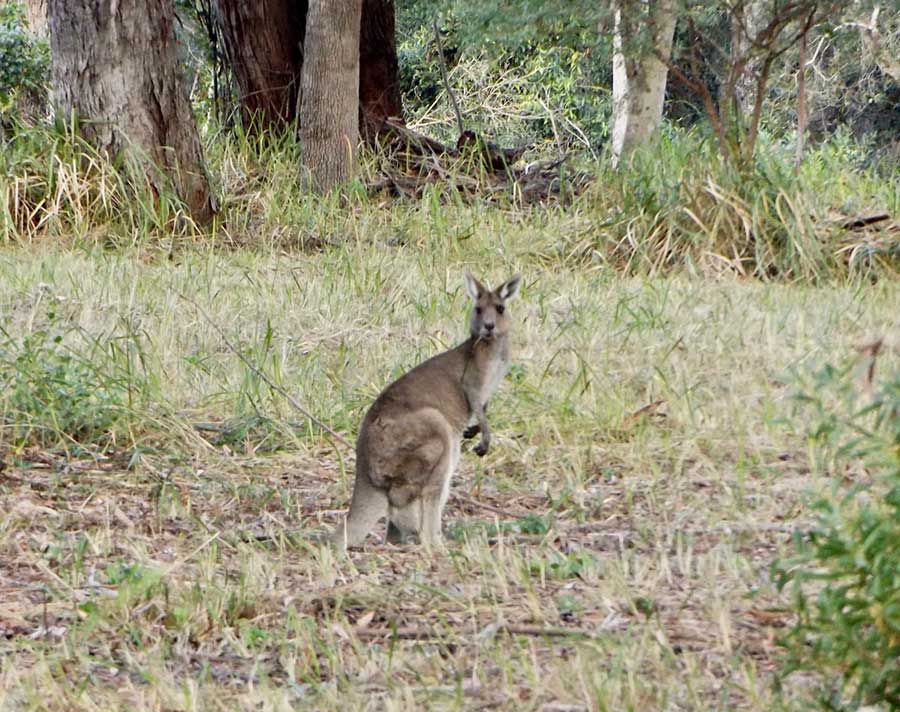
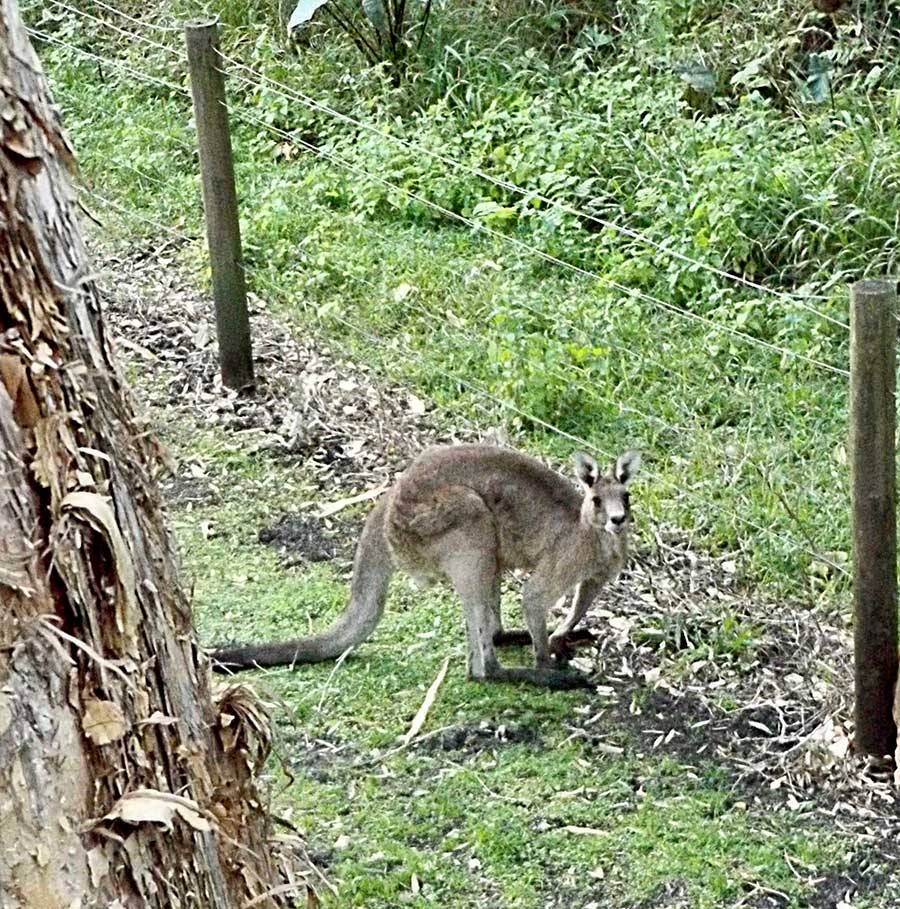
This male Wallaroo never came close to the cabin, despite all the fences coming down. I never saw more than one couple, and usually only one of the pair. The females are paler and smaller, but still stocky and longhaired.

It rained a lot at the Mountain, as this bedraggled little Roo family could attest.

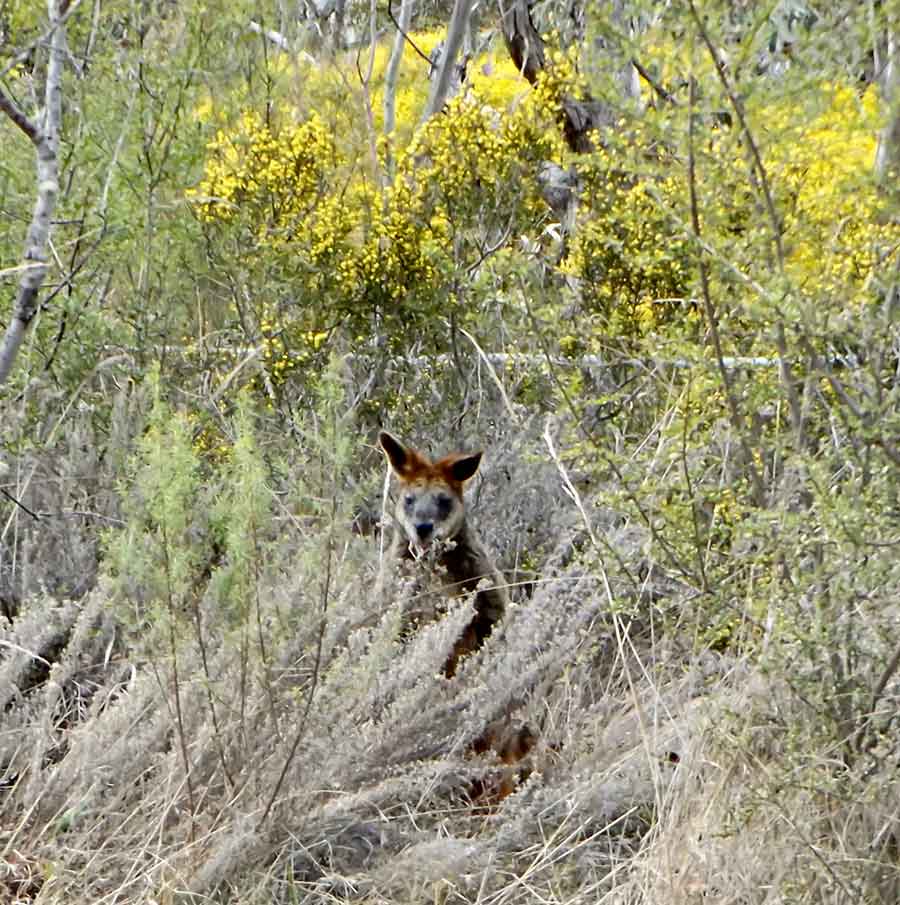
It was the Eastern Redneck Wallabies who made themselves most at home as the netting gradually was rolled out of their way.

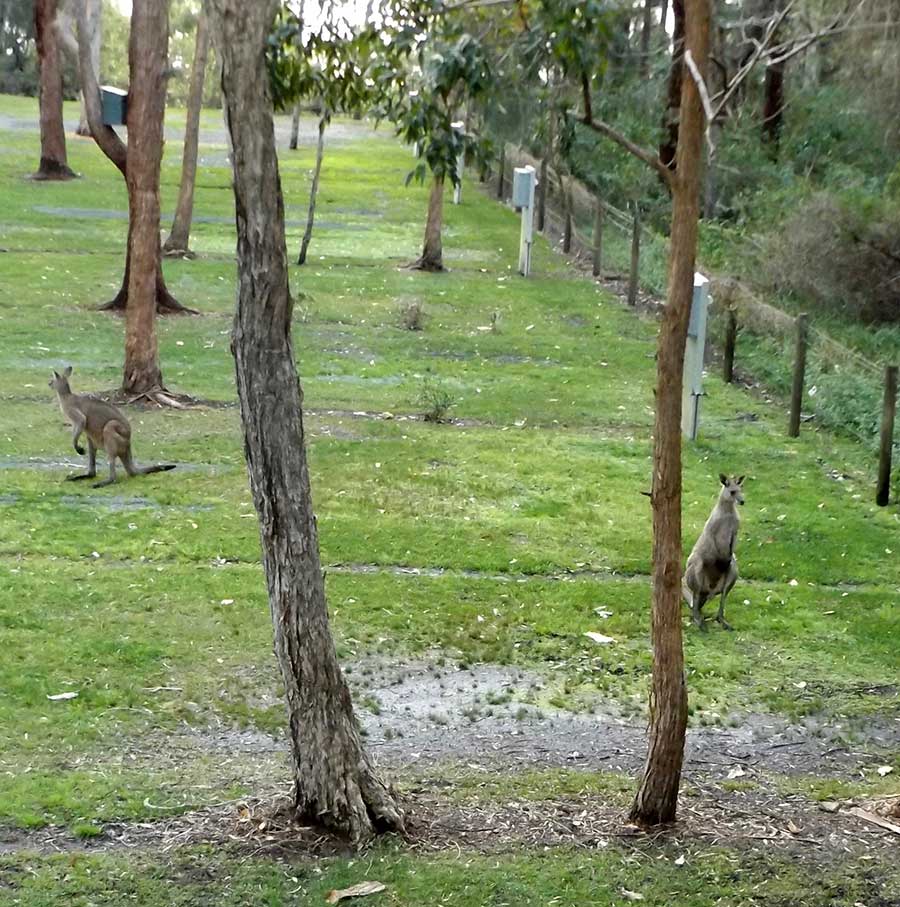
But they were happy to share ‘my’ space with the Eastern Grey Kangaroos. The male Roo by the barbeque is on alert, as always when I appeared, but if I came no closer he would stay. The females and joeys were much more relaxed.

Here they are all lying about drying off in the sunshine after a rainy spell, with me well distanced.

Being the only human there, I was allowed to witness many aspects of macropod behaviour.

Like these young male Wallabies practice-boxing. They balanced on their tails as they ’stood’, clasping each other and cuffing faces.

The bravado often fell as they overbalanced and did the same, which would usually end the ‘fight’.

Or their methods of cleaning themselves, like sitting back with their tail stretched out in front between their legs, and carefully defleaing it.

Sometimes the joey would help its mother deal with awkward places for the process, repaying her usual role as cleaner.

Not that the young were slack about their own cleanliness, like cleaning their dainty black paws.

When I say the Wallabies were the most relaxed, I mean it! I simply didn’t count, and often had to step over one to get past. I put up a toddler-type gate at the top of the verandah steps, for fear those long feet would get them into trouble.

While there were plenty of these Wallabies at my place, I never tired of watching them, of photographing them. I especially  loved the mother/joey connections, no matter how old the ‘child’, pouch-fitting or not.

Kangaroos welcome

It wasn’t only the gentle wallabies who took over my Mountain house yard once I’d let them in. The bigger Eastern Grey Kangaroos eventually used it too. The families became easy around me, but never the males.  When a male stood erect, he was taller than my gate had been.

This one is clearly ready for chasing a female; their penises were always curved like this, although mostly not seen.

They were slower than the wallabies to venture inside my yard, no doubt concerned that the gates might shut them in. The females and young came first.

The kangaroo joeys were as cute as the wallaby ones, and gradually ceased to bother about me, the only human… and pathetically without a tail.

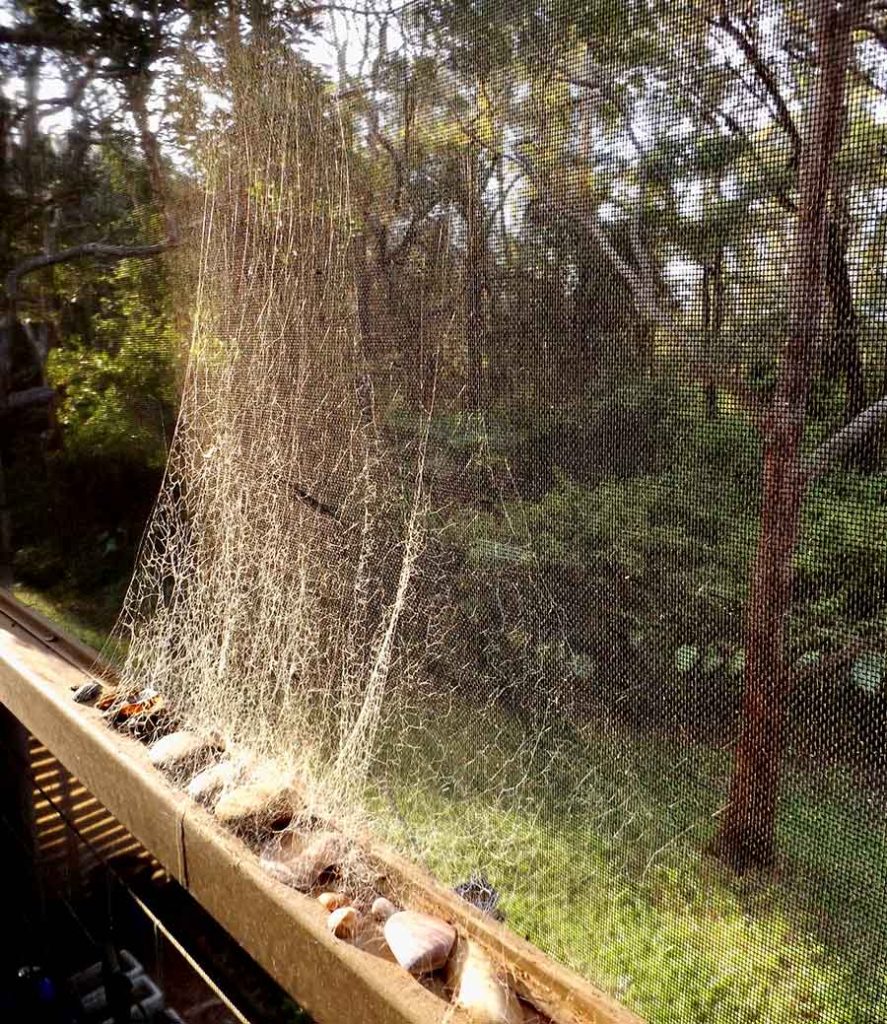
The next drastic step was taking down the netting fence altogether. As you can see, the kikuyu grass was long inside it. That’s a Wallaroo outside; they remained wary and never did venture in far. 

That fence had been a labour to build, and mostly by me, so it was a painful step to dismantle it.

Taking off the netting and rolling it up was a sort of relief and a sort of defeat. I think the roos felt better without it there to possibly hem them in, as even the males seemed more relaxed, preening and cleaning as they usually would.

For me, having an uninterrupted flow down to the small dam allowed better viewing of all the wildlife who came to drink there. Once I saw a female roo even hop in to escape a persistent male! But that was rare.

I felt closer to the wildlife as the man-made barriers came down, while I still regretted the garden dream, the heritage roses…

The price I paid for the overwhelming task and trauma of writing Rich Land, Wasteland was actually incalculable.

Wallaby world

On my Substack posts I am going through my archives, so I thought I might do the same here, in between trips elsewhere and posts about them.

I urge you to subscribe so you get an email notification when I post; it’s free.

When choosing my favourite photo, it had to be this one.

The mum (an Eastern Redneck, my most common wallaby there) had decided my western mud brick cabin wall, not far from my steps, was her spot.

I was overwhelmed when her joey and I locked eyes one day, as for it I was its first human, likely to be the only human it would ever see in its life here on my isolated mountain wildlife refuge.

So that meant that my theme was going to be wallabies, especially wallaby joeys. I never got over how small the mothers often were, and how big the joeys got and were still carried about in that cosy pouch. And besides, they are so very cute…

I watched them go from hairless and totally pouch-bound to hairy and venturing their front legs out, having the best of both worlds. They would nibble the grass as Mum levered herself along as she grazed.

Yet even when too big to fit in the pouch, they could still drink her milk. The mothers would tolerate this for a while, then cuff the young away. Final weaning steps, I guess.

I wasn’t so keen on some of the adults’ habits.

After I had to let them all into the yard, due to the pressure of writing ‘Rich Land, Wasteland’, they totally trashed my garden.

I’d foolishly thought they’d mainly eat the grass that I no longer had time to mow. Hah!

They didn’t eat the leaves of bulbs, so the naturalised jonquils and daffodils survived.

But it was unexpected that they’d eat strong-smelling plants like lavender. This was a rosemary bush!

Nor did thorns deter them, as they did the same to roses.

But they were a daily treat to watch. They could ignore me as the only human, and be totally natural. They knew it was their world.

How sweet is this young one? Even as it poses in front of a stripped heritage rose bush…

No wonder I miss the real world of my Mountain and the real wildlife with whom I shared it.

Southern Flinders

I have inadvertently passed through many narrow gorges that were part of Mount Remarkable National Park on the road to get to Mambray Creek

Because I didn’t stop, I realise I am a bit over gorges.

Where I will camp for a few nights is near a small one, beside the partly dry Mambray Creek.

There are only a few walks short enough for me. They are mostly through native pine forests, with plenty of the amazing Wira or River Red Gums, in all stages of survival. No wonder the Nukuna people revere them so much.

This one was forming a useful bridge as an alternative to the rocks in the creek crossing.

So many of these magnificent trees had been almost split in two or burnt out, and yet they still supported a living section of tree, and all the myriads of lives that this entailed.

Much in demand by everyone, but only over-cut and over-used by settlers, the mighty gums were not appreciated and protected in the past, as they are now.

The Mount Remarkable Range is the southern Flinders Range, of 800 million year-old sandstone.

You can even see the fossilised ripples of beach sand from its time as an ocean bed.

This is the last and most gentle part of my Flinders odyssey.

Like all of the Flinders it is very rocky, and the patterns and colours of the rocks and their lichens could absorb me forever.

Along the track I passed two kangaroos, quite dark Western Greys, too involved in courtship to bother about me. From my time at the Mountain with Eastern Greys, I recognised the ritual…

On another walk, I had good views back over the range, and was delighted to see that one of the millions of bush flies here had strayed into frame at just the right time.

At the campground, almost everyone, including children, wears a black net fly hood under their hat, so groups of unidentifiable people wander about looking like aliens.

I am wearing one now, even in my van, but hatless. It makes walking awkward, as you proceed with dozens of small black flies bobbing about within an inch of your face.

From that same hill, looking west I could see the blue of Spencer Gulf across the plain.

The end of the Flinders…

Gritty Griselda

As the day dawns cloudy over Griselda’s Hill, I am happy to tackle this shortest walk here. Not being a national park, it does not have as much useful information re the length of the walk and what it involves.

A flock of Little Corellas gathers near my camp as I leave.

I don’t know anything about Griselda but her Hill is steep and rocky, and gets steeper and rockier as I climb.

Yet plants grow on most of the harsh hillside. Here masses of Silver Mulla Mulla bloom, in greater profusion than anywhere else I have seen it.

I almost reach the top, to the level where the Rock Grasstrees (Xanthorrhoea  quadrangulata) begin.

I turn to take in the view, seeing two of the observatories in this world class Dark Sky place. They were one of my reasons for coming here, but the long weekend and school holidays mucked up my schedule.

But as I refocus on my close view, with great surprise I notice a wallaby sitting right near me. 

I say hello. We look at each other for some minutes.

I praise her beautiful striped tail and ask if it ends in a point or not.

She doesn’t reply, but instead hops up higher to show me the thick end.

I later ask at the shop for any info on the animals here, but staff seem to be all backpackers, as at Wilpena.

This is, however, a Yellow-footed Rock Wallaby. I just didn’t know about that spectacular tail.

What a special meeting…

She makes me reconsider where I am. The height is now considerable, and I am not one for heights. I start to feel that pull to falling… this is beyond my comfort height.

While I am inclined to keep going, as I am so close, do I need to?

No.

I love the rocks here, but I know the trip back down will be an issue, even with my stick to help me balance.

Each step has to be weighed up, as to whether the stones to be placed under stick or foot are loose … which many are … which part of my bifocal glasses will give me the right depth perception, and how do I see what’s growing around me if I must watch my feet so closely??

Griselda, this is not really a walking track… and it is certainly not for someone whose agile mountain goat days are clearly over. 

I turn back and gingerly make my way down, stopping often to take photos.

Harsh it may be, but plenty of plants have adapted to growing here.

This pretty lilac-flowering shrub is Limestone Fuchsia Bush (Eremophila freelingi).

There were lots of these: Tomato Bush, (Solanum quadriloculatum) from the same family as our domestic tomatoes and potatoes.

But I only saw one of this, which seems to have blue borage-like flowers, not purple as all the solanums do here. A mystery?

Now and then among the rocks is a shrub of surprising delicacy, the pale yellow of what I think are Elegant Wattles (Acacia victoriae).

I kept hearing and seeing Willie Wagtail birds, but they are mostly too fast for me to snap a photo.

A great deal of chattering drew me to what i think I also saw at Acraman campground in Flinders; the sociable White-browed Babbler. And they do babble…

I do reach the bottom of Griselda’s Hill, grateful not to have slipped on any loose rocks. It is only then that I notice the sign there which says ’Griselda’s Hill Climbing Track’.

Lack of info: sorry, Griselda, you never said it was a walking track…

En route I spot this shrub, which  has to be Leathery Senna (Senna artemisioides subsp. coriacea), a first for me.

And I am still wondering about Griselda; a gritty girl indeed if she climbed that hill often…

Grand Brachina Gorge

Being reintroduced as part of the Bounceback program, these Yellow-footed rock wallabies are perfectly at home here in Brachina Gorge, where there are not only lots of rocks, but small caves, which is how I spotted this one. They were prized for their fur by early settlers, which is why they became so rare.

Driving through Brachina Gorge, mostly beside a dry creekbed, there are plenty of showstopping rock formations; they certainly stopped me, often.

Note the area of oddly pale and rounded boulders at the foot of the wave cliff.

I needed a guide constantly at my side to answer my questions… how, why, when?

At one point there was a large scree of loose stones, and beside it the rock walls were noted as habitat for the very wallaby species I was so fortunate to have seen.

Look at the huge log pile against the gum to the right; this whole gully floor must be a rushing river after good rain.

Most of the Flinders gorges I have now seen hold very few caves, so the abundance of them here surprised me.

Seeing the exposed roots of the bordering gums, I can imagine such a gully river even better.

Not that I want to see one, as my AWD van might not cope, and there are daily gatherings of clouds, which, as I’m not local, I can’t interpret.

They tend to dissipate and a cold breeze dominates daily, which does not drop at night, but gusts fitfully and often strongly, so I keep waking up and wondering if I shoudl pull down the roof.

 I do worry about rain as there are many dips and fords for the many currently dry creeks.

One dry day at a time…

After Tasmania

I am now back home, and I find that Tasmania has unsettled me in various ways.

It is small, but at the same time vast and varied, and full of contradictions.

Yes, it has much natural beauty, and that is what I concentrated on seeing, experiencing.

I deliberately did not return to places I had briefly seen before on work trips, like the spectacular Tasman Peninsula, or the historic towns.

The tree fern forests, the mossy walks, the myrtle confetti, the mountains and lakes, the crystalline turquoise east coast waters, the stunning rocks, the sheer amount of trees … all memorable.

Unfortunately so is the sheer amount of roadkill and the seemingly complacent attitude of drivers, judging from the multitude of squashed small furry native creatures. And perhaps of the government who does not lower the road speeds for everywhere from dusk to dawn, to try to protect them. 

The history of Tasmania’s occupation and the relentless pursuit of its indigenous people rings loudly for me. The cleared lands full of sheep or apples or hops or tree plantations or tourist attractions are as loud as the wilderness appeal. 

And there are far too many tourists like me everywhere. A friend suggested that, like Lord Howe Island, Tasmania ought to place a limit on the number of visitors at any one time. 

Tasmania must not be allowed to become a theme park, a parody of itself. To protect all that is special about it, its nature must be valued more highly, not paraded for a fee.

If I had to name the highlights of my time there I would say one was the sighting of an Eastern Quoll.

And the other has to be the Michael McWilliams exhibition in Launceston, which sums up most of what I feel about Tasmania: Be sure to visit the exhibition website here.

The trip taught me two things: a) I am not a traveller, but a camper for longer times than overnight, and b) I could not live there because of the roadkill attitude. 

I may visit again, because I missed a few critical places, such as Hartz Mountain National Park, and Corinna, with the road closed due to bushfires.

In all, Tasmania is overwhelming; I am glad I went – although it was foolish to think a month would be enough – and I will be processing the experience for a long, long time.

Thanks to all who bore with me and followed my travels and thoughts on this blog.

Coastal kingdom

After so many forests and ferns, mountains and mosses, I was ready for a change pf landscape and vegetation. Narawntapu National Park provided just that… a coastal kingdom for the many creatures that live there

Like most National Parks, its roads are restricted to 40kmh, for the sake of wildlife. I think speed limits on all Tassie roads should be reduced, given the amount of roadkill. 

Due to the windy conditions I was advised to camp at Koybaa, which was protected; it was quiet, with only one other invisible camper, and I felt at last as if I was in the bush — without people.

Next morning I walked first to the bird hide at the wetlands, but too late, as there were only a few ducks about.

And then on — and up — to Archer’s Knob.

The walk went along a sandy track through such diverse vegetation that I was constantly taking photos.

Like these paperbarks, clearly designed by Dr Seuss, as I have noted elsewhere, with their little topknots of leaves.

There were many swamps, both water-filled and dry. The paperbarks did their best to infill in massed numbers.

There were wind-battered older trees, like this one with its feet crossed.

Plenty of pademelons were still out and about, relatively unfazed by my trespassing in their kingdom.

I saw only one snake, black and very shiny. I waited until it had long left the narrrow track. Whatever it was, I knew Tassie’s three snake varieties — Tiger, Lowland Copperhead and White-lipped — were all venomous.

On top of Archers Knob was a colony of grass trees, waving gently in the breeze as if signalling.

Looking back over the Park, it was easy to see why it had such vibrant wildlife, from water birds to macropods, as it had such varied habitat.

In the other direction, at the end of the pristine and empty Bakers Beach, was Little Badger Head and Badger Head itself.

I loved the denseness of the bumpy bushes and curving trees; such perfect places for critters to live and hide in.

Narawntapu is a coastal blessing.

Huon heights

Whilst I am a wuss regarding heights, I decided I would gather up my courage and do the Tahune Airwalk, in an ‘eco-tourist’ complex which is a slow 60kmh 30 minute drive through plantations from Geeveston.

But it promised a rare mix of rainforest, giant eucalypts and Huon pines.

I was about to start when the rain came in; by the time lunch was over, it had stopped.

The bridge over the Huon leads to the two walks I would do. 

A trio of horse riders surprised me by appearing from a side track; and no, they were not here for the Airwalk.

Despite what their brochures say, the Airwalk does mainly pass over forests that were burnt in the huge 2019 fires, as most of this area was. It is still an interesting walk – and not really scary. I am giving the swinging bridge a miss…

Even enormous and ancient Eucalypts (obligua especially) were killed in those fires.

From the Airwalk, beyond the Huon River, you can see forests that were not burnt. 

There is plenty of information provided here regarding the post-fire regeneration of different species.

From the Huon Walk, you can gauge the power of this river at times from the large logs piled up along its banks.

The first actual Huon Pine we are pointed to is small, old and damaged. We know that Huon Pines were cut wholesale in the early settler days, floated down the rivers and used for all sorts of unworthy purposes.

We now acknowledge that Huon Pine is an ancient, very slow-growing tree, endemic to Tasmania, and it is now never cut down. Only the stockpiled remnants are allowed to be used, valued for the fine grained durable wood.

Huons need water, so favour river sides like this.

But we do see plenty of other sorts of trees that are old and grand… and still alive.

Trees like these put our puny lives in perspective.

However, the best thing about the Tahune was that outside the Visitors Centre I saw this young Eastern Quoll gambolling about, just as I’d always imagined them in the wild.

They are a cousin of the Spotted-tailed Quolls I had at my Mountain, but so much daintier.

I thought my day was made.

Then, coming back into Geeveston, I saw this fantastic owner builder creation-in-progress: Castle Phoenix.

Wild creatures and weird creations: what more could I wish from a day? 

Here be dragons…

My new place has families of Eastern Water Dragons (Intellagama lesueurii lesueurii).

They mainly sunbake, even in the middle of the road, or perch on raised plantings in the garden.

Liking water, they do swim; I have seen one here jump into a bucket half-full of water– incidentally scaring the daylights out of me!

Often mistaken for a Frill-necked Lizard, they are beautifully patterned, with the most elegant long toes and fingers. Their heads are always up, questing, curious?

Last week a visiting friend, Jane, seemed to have special appeal as the largest Dragon, the male I assume, came up onto the verandah where we were sitting. He was almost under our chairs, pointing his spade-shaped head this way and that. 

They are mainly insectivorous, but like all sorts of delicacies as they mature, so maybe he thought we had cake — we didn’t, just coffee.

While unafraid, these Dragons are wary, so I wasn’t game to get up to fetch my camera. But Jane had her phone camera, so took these great pictures.

I am very grateful to have them as my resident wildlife.

Goodbye, Blinky Bill?

Just next to historic Roto House and its café is Port Macquarie’s famed Koala Hospital.

Started in 1973, and now with 200 volunteers, this special facility treats rescued and injured koalas, runs a vet clinic and a conservation breeding program, and offers up close and informative experiences for visitors.

The first time I went was near midday and all I could see were furry balls, fast asleep. Koalas do naturally sleep a lot,  to save energy.

Next day I was there at opening time (8.30) and it was quite different. Here helper Geraldine is feeding a medicinal paste to CW, hit by a car, and left with only one eye and brain injury. He will never be able to be released into the wild. 

CW was more than eager to take his treatment, and Geraldine wiped his mouth when needed, just like a mother would.

The pens are roomy, with cleverly designed and shaded structures; fresh gum leaves are placed in each every day. About eight food tree varieties, like Swamp Mahogany and Tallowwood, are grown on a separate property.

There are pens for the permanent residents and closed-off, more private pens for those being rehabilitated, to be released back into the wild when ready. With free entry, the Hospital relies totally on donations.

Visitors do get to see how cute and furry are our iconic koalas… and they also get told how at risk they are. From habitat clearing, from disease, from dogs and cars – from our ‘progress’ in fact.

Australia holds the world record for the extinction of mammal species. How shameful is that!?

In 2022 the koala was officially listed as endangered.

How shameful is that!?

John Williamson was so ashamed when he visited the Hospital and realised the koalas’ plight that he wrote and recorded the song, ‘Goodbye Blinky BIll’, which included the lines: 

‘I don’t think I could stand the shame, knowing that I could
Have saved the world from losing something beautiful and good.’

And yet, despite the enormous bushfire loss of native forests, our governments are still approving the removal of large areas of koala habitat, be it for logging or coal or gas or housing.

As for the Moolarben coalmine expansion near Munghorn Gap Nature Reserve north of Mudgee. Or the Vulcan South mine in QLD. 

With coal and gas mining spreading in the NSW N-W, the Independent Planning Commission said, ‘If coal mining and koalas are to co-exist, then a robust strategy for koala conservation is essential.’ 

Indeed, but that cannot mean the sham get-out-of-jail system of offsets.

Well may koalas turn their backs on us, given we are doing that to their desperate declining situation. It is predicted they may be extinct by 2050 at this rate.

Where are our priorities?

Who will dare say NO to the developers?

Or who will explain to our grandchildren… and to the world;… how we let this happen?

Goodbye Blinky Bill?
Desk life

It’s difficult not to be distracted by the wildlife here, even if I don’t leave my desk. At this second floor height what’s going on amongst the trees is ‘in your face’, so to speak.

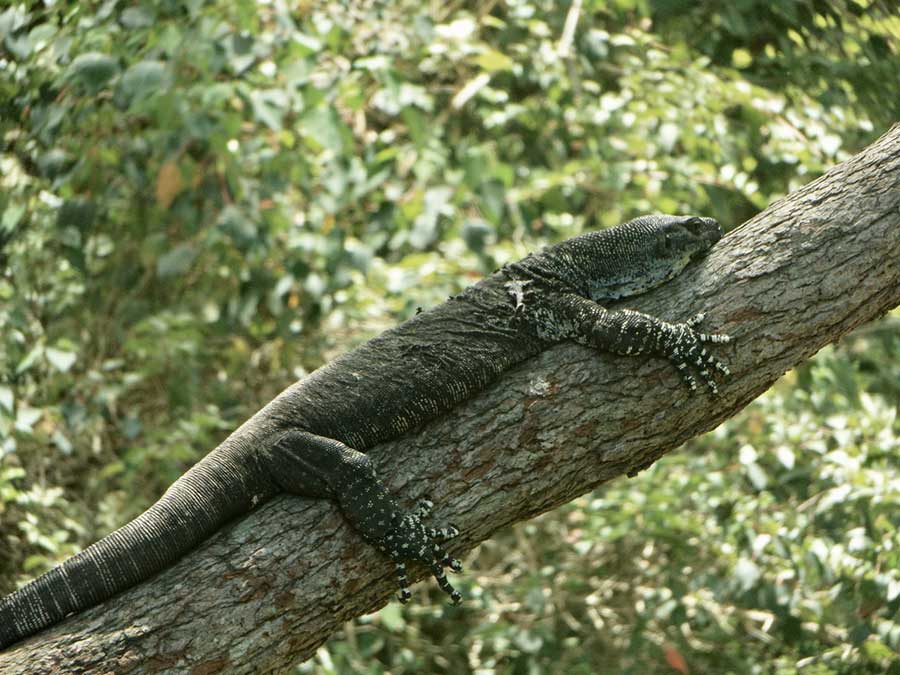
Like this goanna, who decided to climb up and laze on this branch for about a half hour; not after any nest of baby peewees, just hanging there. When done, it turned around – always a heart-stopping manouevre to watch — and slowly gripped its way down, its tail almost overtaking it.

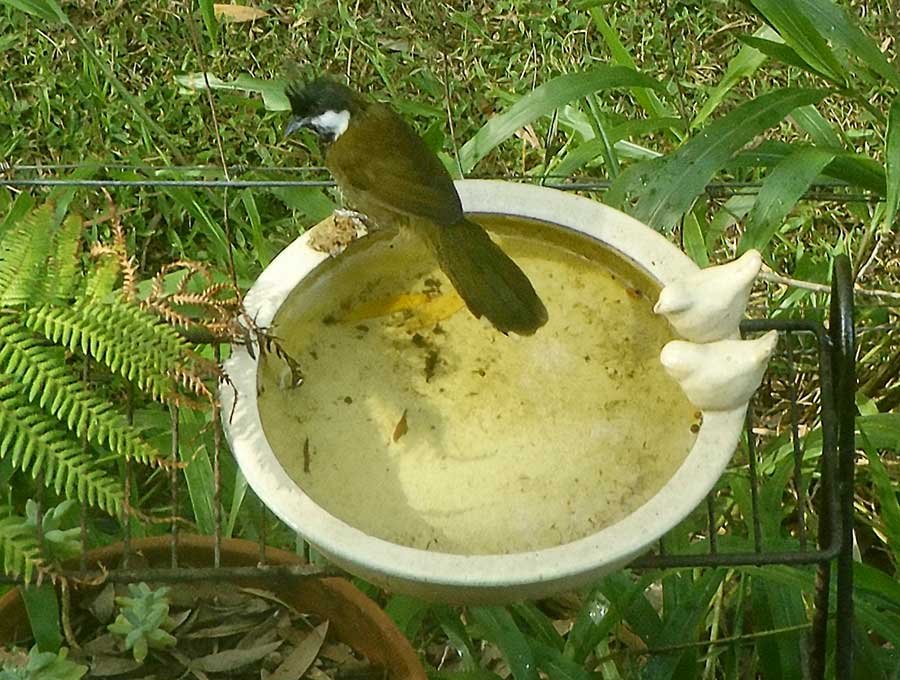
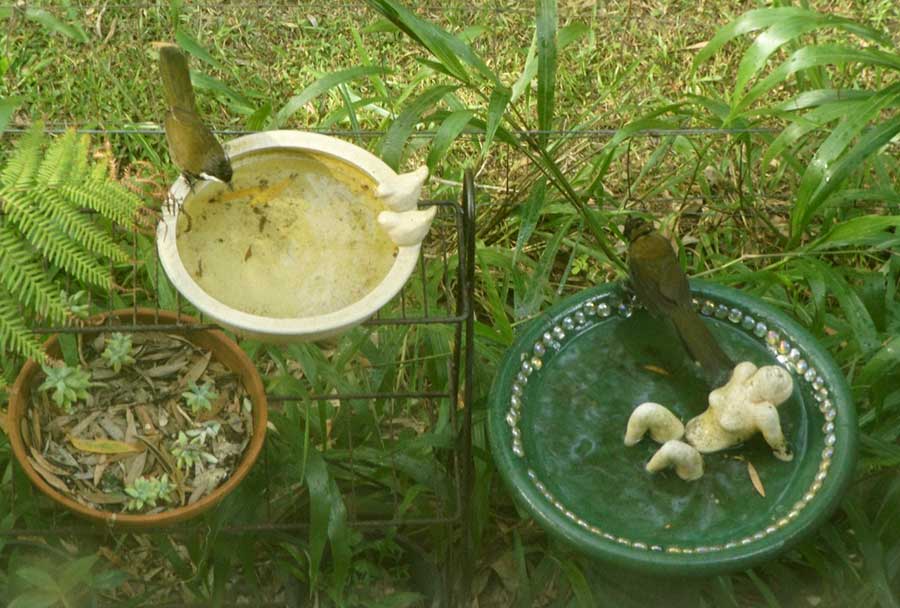
Odd noises often alert me to activity closer to the ground, as in the various birdbaths. This time it was a repetitive soft bird call, and when I checked, there were two birds I had not seen here.  Eastern Whipbirds, I learn, and I had certainly heard the males’ whip crack before.

The female’s call is described as ‘choo-choo’, with which I probably wouldn’t agree, but if they visit again I will listen more closely and come up with a more fitting one. Another book says ‘chuckles and whistles’ — quite an art, summing up bird talk…

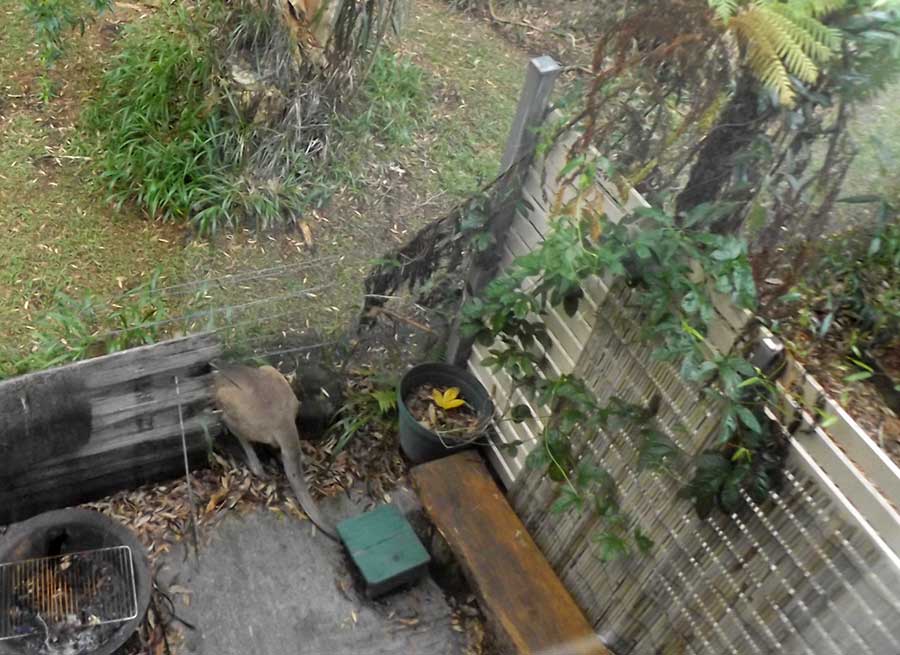
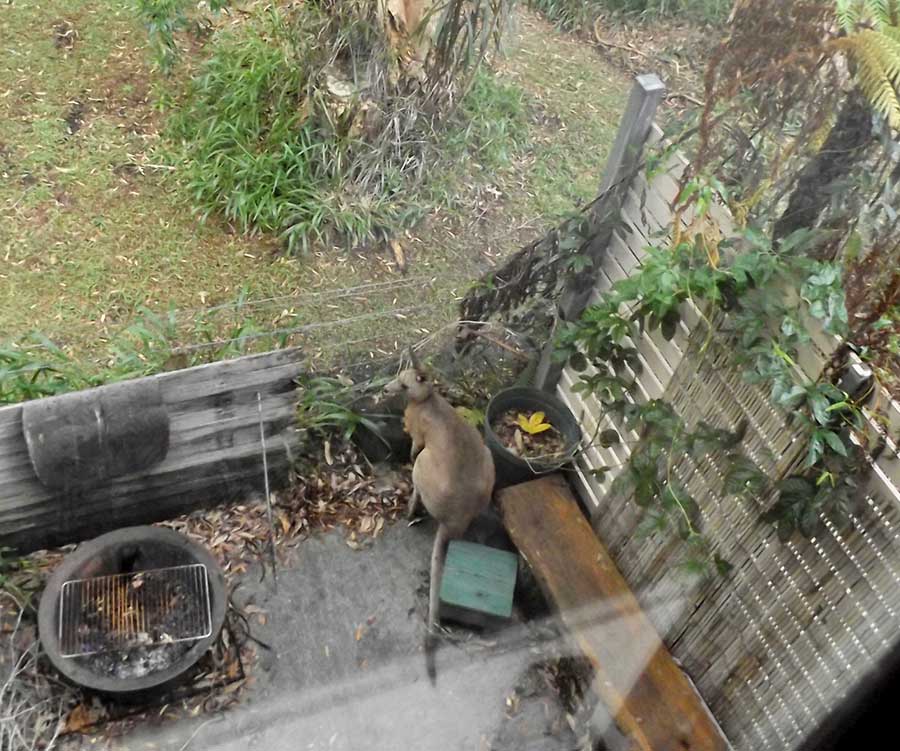
A louder racket made me stand and look down into my small back yard where an Eastern Grey Kangaroo had pushed its way in beside the pigwire fence and was trying to return — but clearly couldn’t find or use the same route.

I was worried about him panicking as he pushed fruitlessly at the fence, but he was no fool. Having realised that no part of his body beyond his head would go through the wire squares, he quickly checked out the rest of the yard, then took a running jump and went over the fence.

Life is never dull here, even through my windows.