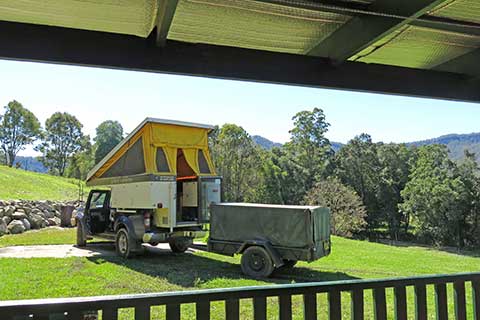
Having been fortunate enough to have gone camping lately, I have been once more cooking on an open wood fire… and loving it.
It took me back to the first year on the Mountain, when we lived in a tent. Being in a forest, there was limitless wood for fires.
Four rocks and an old fridge rack did excellent duty as my stove, as I cooked our food in cast iron pans, and occasionally used a cast iron camp oven for baking.
It also heated the water, in billies made from pineapple juice tins, for our wind-down canvas bag showers. More simple luxuries.
A card table, with its upper legs dug into the ground in an attempt at a level tabletop on a slope, was my preparation area and our dining table.
Of course I was more agile 40 years or so ago. Not sure I’d be so happy now with the squattng and bending needed for this kitchen.
This drawing was done for The Woman on the Mountain, but we didn’t end up including drawings in the book, so it’s nice to revisit them… and to share them.
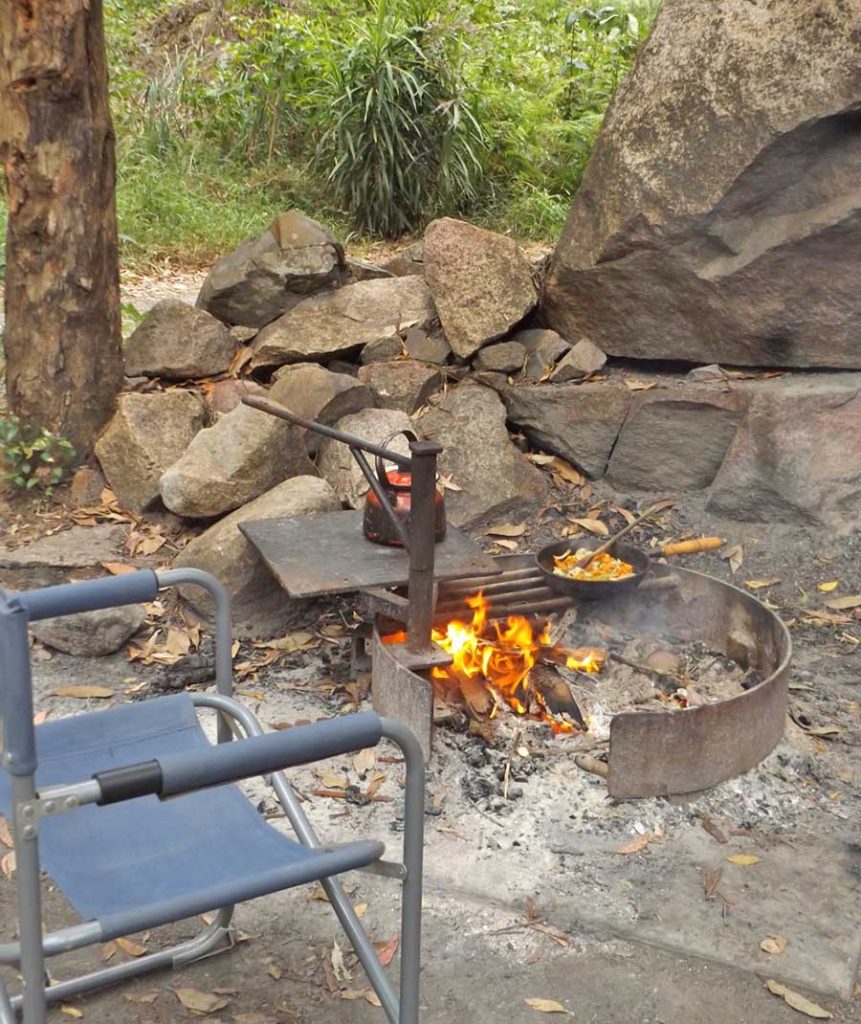
This more sophisticated Forestry model of fireplace that I used recently has a swivelling hotplate as well as a grill. I am still a fan of cast iron, and my blackened enamel kettle is meant for this!
And the smell of woodsmoke came back with me, in my hair and clothes, so I could savour the memories.
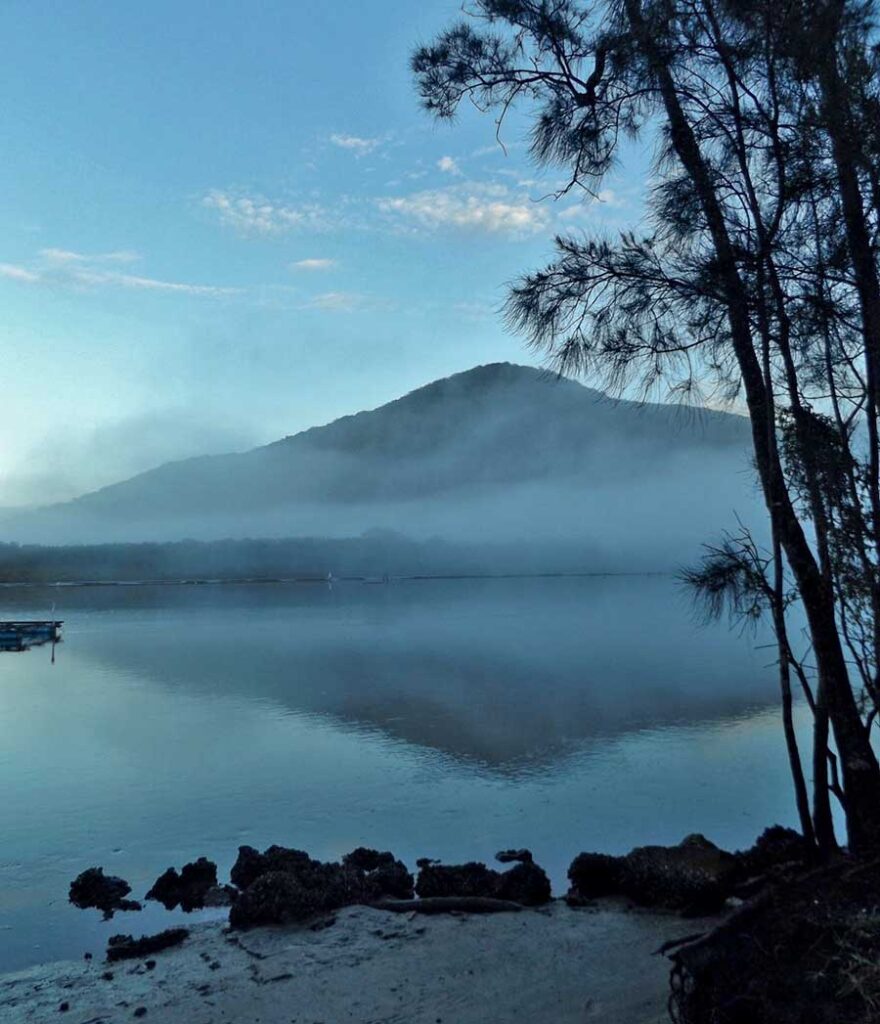
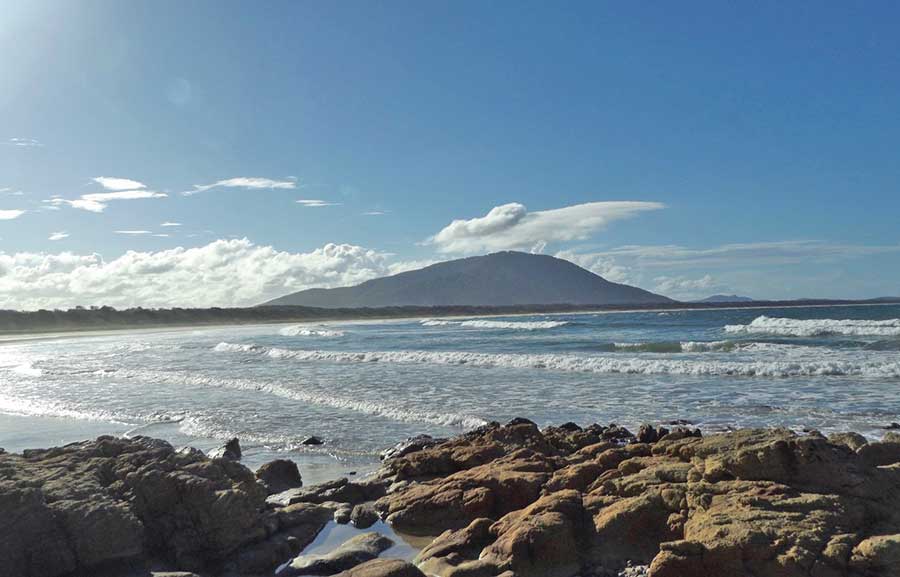
I would like to introduce everyone to my new home surroundings, and to my new mountain, which will be featured often in my blogs. It is Dooragan, or North Brother, near Laurieton. I am near both river and sea and two national parks, so I look forward to exploring and sharing sunrises, sunsets and clouds, and plants and creatures of sea, sand and rocks, mangroves, swamps and mountain forests.
Why am I here? Partly by force of nature.
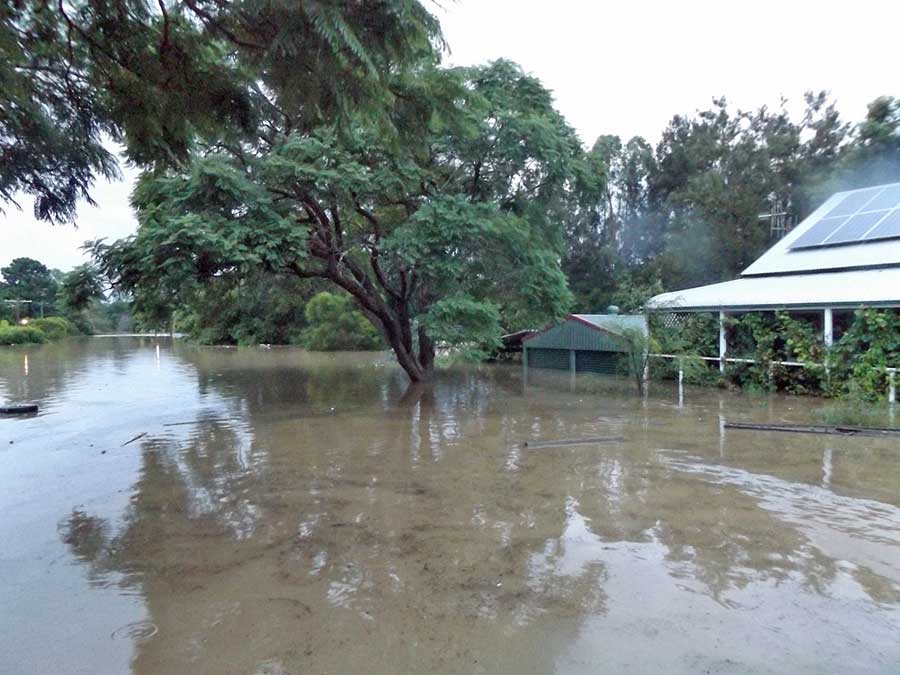
It seems like an eternity, but is about six weeks since I woke up about 6.30 a.m., swung my feet over to stand on the carpet… and found that my bed was standing in water.
Floodwater.
Was I actually awake?! How could this be real?
In water to my knees, I grabbed the torch I kept on my bedside table, and shone it about. The water certainly felt real; it looked real.
Yet I was incredulous.
This was not supposed to happen; I had been unable to get flood insurance due to the zoning, but I had not worried as my neighbouring ‘constructed wetland’ forest had been a ’90s flood mitigation measure that had worked ever since.
Wading out into the hall, my torch showed two yellow discs bobbing about in. The halved skins of a passionfruit, they’d have been in my compost bin in the kitchen… I passed a large container of corn chips that would have been in a cupboard down there…
This was real all right.
Over the night of March 19 the flooded creek/river had silently far exceeded its expected reach, snuck up the hill on which my house sat, and into my house.
At 8.30 that night I’d checked and there was water only in the lowest bottom corner of my large yard, a not unusual occurrence.
I slept soundly. There was no sound, no SMS alert or warning, no knock on the door.
While up to mattress height in the bedroom part of my house, in the lower part (two steps down) it was up to kitchen bench height, and my fridge and furniture … and compost bin contents… were floating about.
My garage, further downhill, was flooded far higher; it was full of tools and camping gear, and most precious of all, the carefully stored boxes of my own books, taped with chalk inside to absorb any moisture, placed on pallets to avoid any dampness… !! They were now just a pile of mush.
Irreplaceable. Heartbreaking.
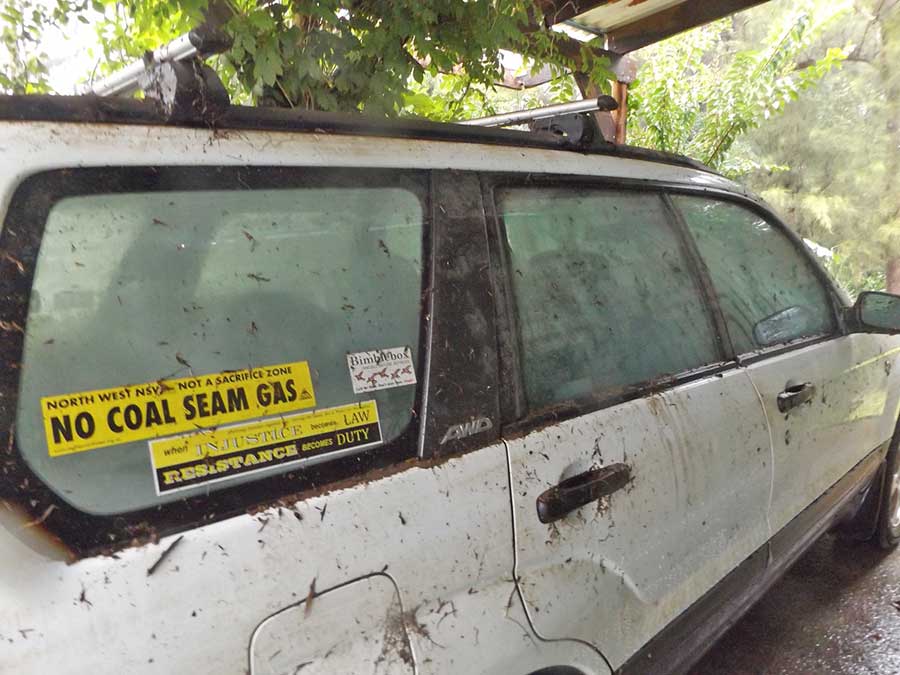
As the SES boat took me and my few hastily grabbed possessions out, I only managed to take the above two photos.
My car in the carport even lower down was under many metres of water, and next day as the water receded, it was clear it would be a write-off… as it was.
When I was allowed back in, SES volunteers helped me take out heavy items like sodden mattresses. Once family could get through other flooded roads, days later, we frantically threw out ruined items large and small, and broke apart lower swollen cupboards and furniture to get the stinking clothes and books and albums out before worse mould set in.
Fixed carpets were ripped up, large mats removed with hope they could be washed and salvaged.
My grandkids dried and separated pages and peeled off photos in the oldest family albums… again, irreplaceable.
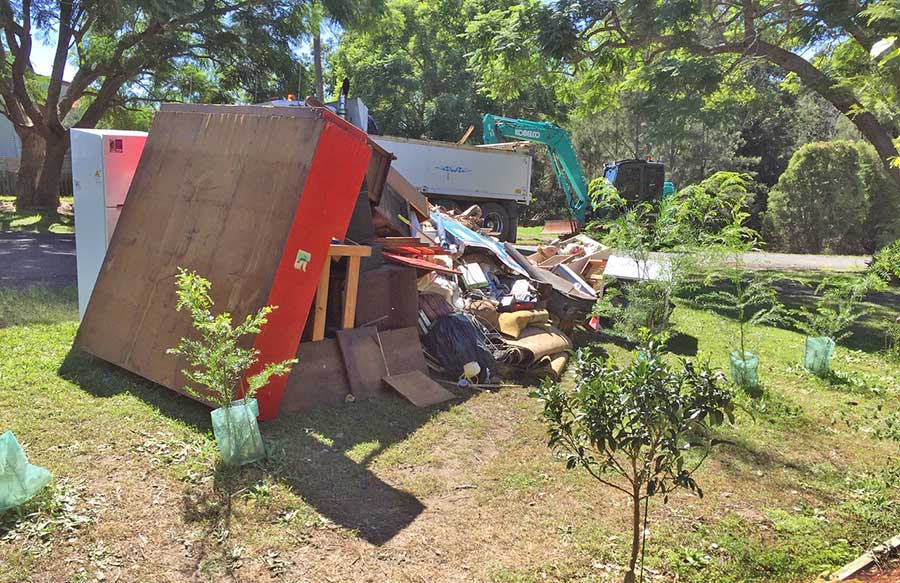
Several mountains of dumped belongings formed out the front, to be picked up by a Council excavator and loaded into trucks. Things like the fridge and washing machine looked OK, but were irretrievably ruined.
It took weeks to empty the place, but the cleaning began apace. Friends and family were wonderful; some washed many loads of linen and clothes, others washed down walls with vinegar; others washed cupboard contents deemed OK to use again, like crockery and pans; I mopped the timber floors… five moppings so far!
Many of you know of this disaster that befell me because my friend David ran a fundraiser, and while I did not look at that until weeks later, a truly humbling number of people donated to help me out. I would not have managed without those funds and I am overwhelmed with gratitude to everyone, whether they gave $10 or much more. Knowing that such kindness and emotional support was out there helped me greatly.
I have since had to pay to have done, and do myself, certain flood-damage remedial work on the house, but being mostly built of timber and timber-lined, it has come up well. Only one added-on room was plasterboard… a costly mess.
Once the underfloor foamboard insulation I’d installed was removed, the old floorboards slowly dried and uncupped. Amazing.
Chipboard does not cope with inundation well either… but the new vanity looks nice.
I’d been planning to sell and move to this smaller place on the coast. Folk had been booked to look at my lovely furnished and decorated house on the very Monday after the flood; in preparation I’d de-cluttered and put things in lower cupboards and moved much to the garage. A double punch to the guts for me; now what did I have to show or sell?
But a few weeks later, they still wanted to look at the empty and cleaned house, despite my being in process of touching up and fixing.
They made an offer; I accepted, and in a few weeks it will be theirs. Only one more trip for me back to finish painting… and say goodbye.
So now I live here. It’s small, but I write this first blog post here looking into the tops of a paperbark forest, I hear lorikeets in blossom-feeding frenzy, a goanna waddled through the carport the other day… and I have but to turn my head to see the river and that Mountain.
Silver linings indeed…
I am tired, exhausted really, but I can see they will be a comfort once I get past the shock, which has not quite hit as I have been so very busy.
Again, thanks to everyone for your support and good wishes.
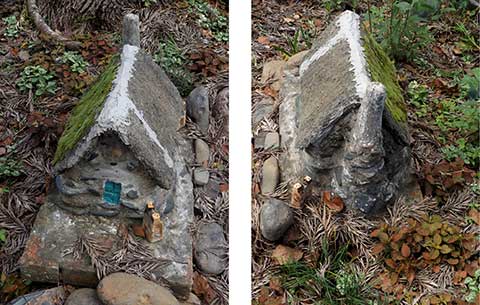
When this was built at the Mountain, I never imagined it would have to be moved. But it has, twice.
There was no way I was leaving it behind anywhere, but the last time was too much for it.
The beach pebble chimney survived its cracking, staying vertical and attached.
But I had to patch the ferro-cement roof– and pretty rough it is.
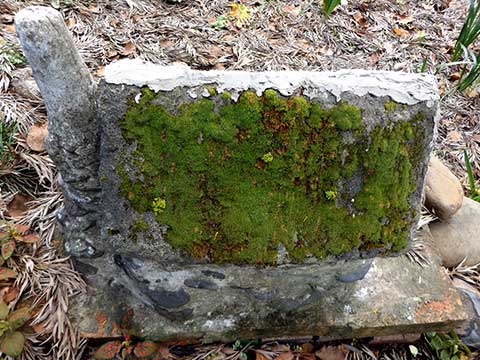
I am waiting for it to weather grey and gather lichen, to fit in.
But on the south side the roof has fitted in here beautifully, with the moss as thick and velvety green as ever.
Here the little cabin is placed right opposite my side steps, so I can sit and look at it, say hello as I pass…
This extract from The Woman on the Mountain, of the original construction and site, will show you why:
Dad’s place It’s a pretty good place, with a view across the dam to the bush, terrific sunsets, and a couple of wattles just in front.
Now how does that song go?… ‘It’s Ju-ly and the winter sun is shining, and the Cootamundra wattle is my friend… All at once my childhood never left me, ‘cause wattle blossom brings it back again.’
Yeah. And I got plenty of time for memories now.
My daughter often drops by for a chat, and my granddaughter brings my great-granddaughter to see me every few weeks. A right little card, she is, picks me fresh flowers every time she visits!
Much better than bein’ cooped up in one of them boxes, side-by-side with all the others, even if they do have landscapin’ and rose gardens. Give me this horse-cropped pasture any day.
We’d decided to build a cabin on my block for Dad. No reason why we three women couldn’t do it, if I kept the plan and method simple. My sisters had no building experience, but Dad wouldn’t care about rough edges and wonky lines.
As he’d been a carpenter by trade, I thought it best not to use timber; might make the mistakes too obvious, be an irritant, even for an easy-going bloke like Dad. Considering bushfires, and what was handy, a stone cabin seemed best.
I’d chosen a spot by the wattles, near some big rocks that would make perfect beer-o’clock sitting spots. My sisters arrived, and approved the site. We set to work. Citybased Sister One looked so funny in my spare gum boots and old felt hat that I wished Dad was here to see. She was to pass materials to me, while Sister Three was assigned to mixing cement.
We levelled the site, and boxed in for the slab. Our arms were aching by the time we’d mixed and trowelled and smoothed, but satisfyingly so. Sister Three went to make tea for smoko while Sister One and I watered and covered the setting concrete.
Next day we started the walls, leaving enough of the slab exposed for an all-round verandah. He’d want that to enjoy the view. It was a small cabin, but we fitted in a window on the eastern wall, for morning sun, and another on the northern wall, beside the door.
Dad loved an open fire, but Mum had put her foot down and insisted it be replaced by a less messy closed-in one, of a nasty shiny brown with a mean little mica window behind which the fire struggled for identity. It did warm the room, but not our hearts; it wasn’t even worth looking at, couldn’t conjure up a single flickering image or inspire a dreamy thought train…
So we made a big chimney on the west, where we could imagine him in front of a fine blaze, cooking his snags on it if he wanted. And making forbidden messes! Narrowing to a freestanding column, that chimney was a challenge, but ended up only slightly askew.
On the last evening of my sisters’ visit we drank to Dad as we admired our work, joking about what he’d think of it. He’d surely laugh at us girls as builders, especially Sister One who never went anywhere without makeup, and for whom a broken nail was a disaster. But for him she’d worked au natural and got dirty without complaint.
They had to return home, leaving the roof to me. Cutting tin was too hard, so I was using ferro-cement over chickenwire and hessian. Dad would shake his head at this unconventional method, but it would make a good watertight roof.
Now came the hard part. All the roofing materials ready, I went to get Dad. He had to move in now, because neither the door nor the windows of this cabin would open; my roof would close it forever.
As I carried the grey plastic sealed box I could hear small shifting gritty sounds that made me tremble; these were more than ashes.
He fitted snugly in his cabin.
I draped the hessian over the wire. He’s gone.
I hate doing this.
‘Sorry!’ I sobbed, as I worked the cement in.
Interment is… so… final.
It’s done.
Relief films over the hole in my heart.
Rest in peace, Dad.
I’ll be down for a beer tomorrow at 5.00. OK?
You can buy The Woman on the Mountain and my other books here.
This drawing was meant for Chapter 5, ‘Living for Weekends’, of The Woman on the Mountain.
We’d moved there into the still very basic cabin, and I’d taken the writing work from my old design firm…
In a way it’s as if I remained part of the company even after I’d left and moved back here for good. They used to call me ‘our woman on the mountain’, as one says ‘our man in New York’, although the connotations of gumleaves and gumboots were probably less impressive.
They had to tolerate a long and turbulent teething period in those pre-email communication days. We were using a program called Carbon Copy (I think) where my computer linked to theirs via a primitive modem. I’d try to get the modem to work on my dreadful phone line, waiting for that magic sound, the electronic gargle of a successful connection. Someone had to sit at a computer at their end to receive it, and stay there to respond, even if it was unbelievably slow. I’d be sitting here trying to get it through, never sure if the person down there had given up, or wandered off to make a coffee or take a phone call. To find out, I’d have to disconnect and ring them, as I only had one line. Then we’d have to start all over again. Hair-tearingly not ideal.
I think that was when I first discovered the release to be derived from screaming Charlie Brown one-liners — ‘A-a-a-a-rgh!’ — from the verandah.
… But at least I was living and working here, even if conditions weren’t ideal. … I’d be shivering at my desk at the other end of the cabin from the combustion stove. Working on the computer, I’d be wearing fingerless gloves, beanie, thick socks and boots, tights, leggings, long woollen skirt, singlet, skivvy, woollen jumper, vest, cardigan and shawl, with a rug over my knees. Dead elegant — and cold. I cursed again the uninsulated roof.’
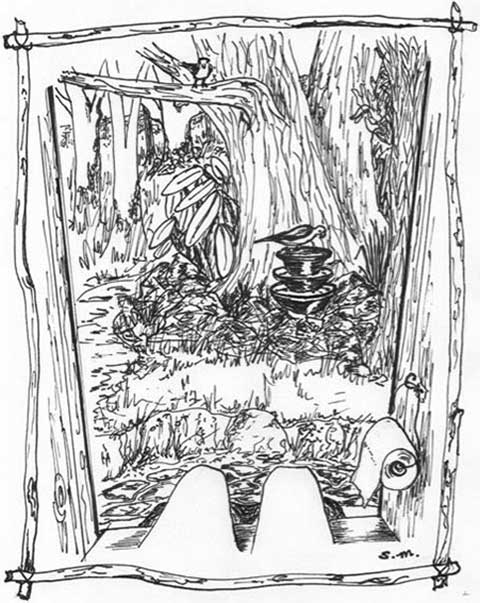
The sun on your knees, a view of birds and bush… who’d want an indoor loo? This sketch and extract is from The Woman on the Mountain, Chapter 14, ‘The Simple Life’.
‘Contrary to popular mythology, the simple life is not found in the country but in the city, where you simply pay your bills and press a button for everything you need, and you don’t have to know how any of it works or be able to fix it yourself.
…
‘My next self-sufficient system is sanitation. I have what is called a ‘long drop’, a big hole in the ground with my old jail’s lidded seat over it and a shelter shed over that. It was originally a metre-cubed hole, dug into bedrock with pick and crowbar in 1978. I’d assumed it would last a few years, but it’s still going. Beside the seat is a lidded enamel canister which officially says SUGAR, but as nobody takes tea there I think it’s safe from confusion with my Texta-scrawled LIME. A sprinkle of the latter now and then is enough to keep the material breaking down, while an evaporation pipe dries it out and reduces the volume.
I always thought I’d build a dry composting toilet one day, but the only real difference from my current one would be that I’d get to use the resulting compost.
A few overly civilised visitors have had difficulty using my sanitation arrangements. I’ve never asked whether this was from the dark pit yawning beneath them or the idea of communal storage, but the ensuing psychosomatic constipation was real. They couldn’t wait — or rather, they could — to get back to a proper flushing loo. I feel sorry for them, so unable to accept that they’re part of the animal world, with the same basic processes necessary for survival. They were possibly also uncomfortable without a door to shut, but the toilet faces away from the house, and they wouldn’t see the birds and trees otherwise.
Having grown up with a pan toilet — a far-too-short drop — I consider mine quite manageably distant and salubrious. That toilet, complete with harsh and unabsorbent newspaper squares impaled on a large nail, was dark and spider-scary because it wasn’t done to leave the door open; and smelly, often maggoty, because it was never emptied soon enough. When Dad worked away from home for a month once, Mum and I had to do it, and I understood why he’d kept putting it off. But that first row of orange trees, in the burial range, had the glossiest, greenest leaves, and the biggest, juiciest fruit, of all the trees in the orchard.
The disadvantage of my toilet is that it’s a fair hike up the hill when you’re in a hurry or it’s raining. If the pit ever does fill up, I’ll build the new toilet on the flat, still outdoors, perhaps reached by a covered walkway. And I’ll plant an orange tree on the old site.
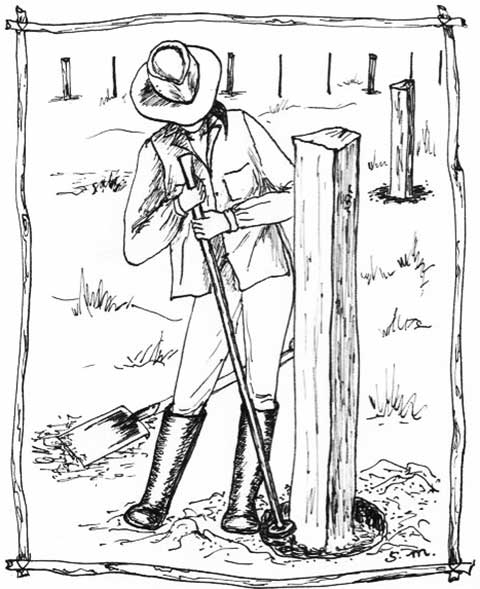
This drawing was meant for Chapter 12 of The Woman the Mountain, ‘While the woman’s away…’ which is mainly about the wildlife moving in and taking over when I wasn’t there.
Here’s the relevant extract about one of the ultimately futile attempts to keep them out…
When the rain finally stopped, I began fortifying the fence against the wallabies, slowly and erratically, depending on when I could afford another roll of chickenwire. As I clipped it on to the old hingelock netting, I was forced to get up close and personal to the past.
I’d erected this house fence ten years ago, when I came back to live here. My dream had included a large garden in the midst of the regenerating bush and its abundant — and voracious — wildlife. That required a netting fence. As my partner was already engrossed in his creative and income-earning pursuits — absolutely single-mindedly, as many men can be — I did most of it myself. I dug the holes and tamped around the wooden posts with the head of the crowbar, which isn’t easy to do on your own and still have the heavy posts end up roughly vertical. A fair bit of boomps-a-daisy balancing was needed.
In between the wooden posts I banged in the steel star posts with my wonderful ‘putter-inner’, a heavy iron cylinder, closed at one end, that a friend had welded up for me. The shop ones, called post-drivers, have handles, and I suppose they are all bought by weak women — Real Men use iron mallets that I can barely lift off the ground, let alone above my head.
And I’m no weakling, despite being small. But some jobs don’t only depend on strength. They’re just bloody impossible without the right tool — like my ‘puller-outer’, a shop-bought manual post-lifter, which makes removing star posts and tomato stakes amazingly easy, and which, I suspect, even Real Men might use.
These are the sort of tools I love: dead simple and very effective, requiring neither mechanical knowledge nor great strength, needing no manual, using no fuel, hiding no spark plugs, able to be forgotten and left out in the rain without damage, enabling little me to do heavy work. In fact they’re the sort of old-fashioned items that are usually discontinued nowadays — too simple, too enduring, a one-off purchase that brings no economic and ongoing joy to anyone but the buyer. What a useless thing to keep manufacturing!
Posts all in, my partner strained up several strands of plain wire for me to attach the hingelock to, as I can’t seem to get into my head how to set the chains and teeth of my fence strainer so it works. Or perhaps I’m just scared of the way it bites and snaps and strains almost to breaking point.
Then I unrolled the old hingelock netting, relic of my first dream of a bush life seventeen years previously. My then husband and I had fenced in several large areas for vegetable gardens, since we thought we’d grow fancy foods like globe artichokes and asparagus — and back in the 1970s these were fancy, rarely seen in shops. After the marriage broke up, so did the fences, only more slowly.
When I wrote my first book, The Woman on the Mountain, I originally intended to illustrate it. After all, if Gerald Durrell could have illustrations in books for adults, why couldn’t I? In the end, the book having grown longer, we decided not to use the pen and ink drawings.
I still have scans of them, and as I hate waste, I’ve decided to share some of them with my blog readers, accompanied by relevant extracts from their chapters.
This one was meant for Chapter 3 – ‘Close to the elements’, as we certainly were, living as we did for fifteen months in a small secondhand tent. Except for wet weather, we really only slept there; all the real living space was outside.
‘Yet despite the extremes dealt by the elements, that first year here, living mainly outdoors, remains the happiest of my life.’
My three-year-old daughter and five-year-old son loved it… and so did I.
‘For dining, under the spreading arms of a white mahogany tree we had set up a card table and canvas director’s chairs, with holes dug in the ground for the uphill chair legs so diners didn’t roll down the slope when eating, as several unwary visitors had done. As they were a little tipsy at the time, they rolled easily and didn’t hurt themselves, although the sight was so funny that the sides of the callous and equally tipsy spectators ached for some time.
‘Our chosen clearing had appeared to be a gentle slope but actually was relentlessly unflat, as each small area that needed to be level soon proved. Everywhere involved walking uphill, to or from, and we got very fit, especially carrying buckets of water up the steep incline from the spring. That was excellent for deportment too; only my straightest back would keep the buckets from bumping into the slope ahead and spilling.
‘My cooktop was an old fridge rack balanced on four rocks, my cooking equipment was disposal store cast iron — camp oven, frying pan and saucepan — and one heavy soup pot. From our Merriwa camping weekends I’d developed quite a collection of recipes for one-pot or one-pan dishes. For those weekends I used to cheat a little to compensate for the absence of bench space, like making the dough and rolling the balls for chapatis at home, in which form they’d happily sit until I was ready to flatten them and cook over the fire to accompany the Saturday night curry. Now I had the luxury of the card table as a bench.
‘The camp oven, buried in hot ashes and coals, worked well, but I could only bake one thing at a time in it. We bought a rusty fuel stove for $10 and set it up close to the big tree above the ‘kitchen’.
‘The first time I used it I wrote (in my diary):
Took a long time for oven to heat up but finally cooked pitta, pumpkin pie and two veg. strudels in it. Flue melted its joins and blew off.
‘Here’s another baking morning.
Lit fuel stove — baked cookies first, then two loaves bread, then prune loaf, then Rieska [quick rye bread for lunch]. Used top to warm yoghurt, de-candy honey, cook chickpeas, etc. All done by 12.30. We got sand and rocks for last trench. Finished that by evening.
‘Was that me, that so-organised, energetic young woman? Where did she go?’
As at my old Mountain, the sky here is as important for my visual delectation as the land.
And I am as fanciful about what it offers.
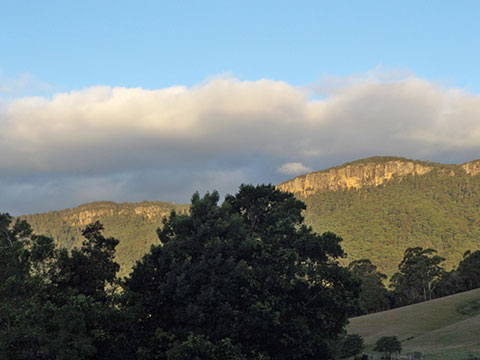
Like this sunrise, where the billowing white foreground cloud looked so like bushfire smoke, unlikely as that was, that I had to go out and sniff the air to check.
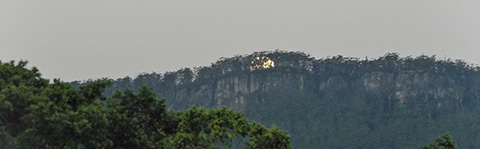
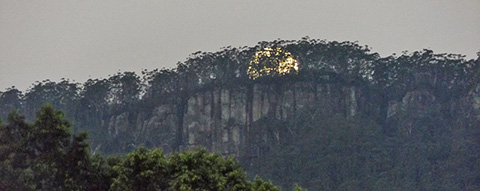
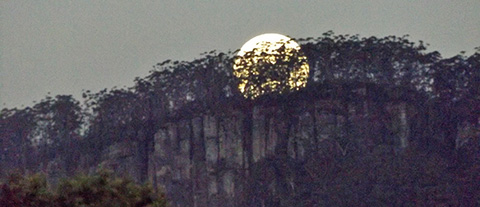
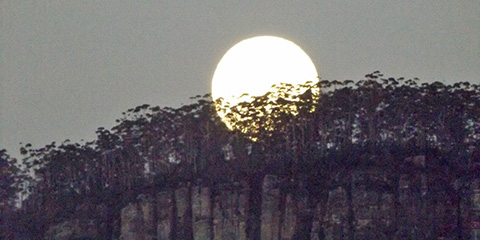
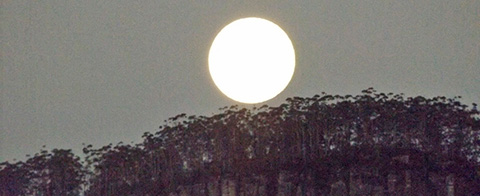
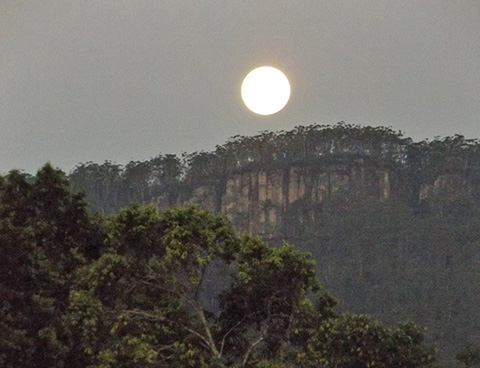
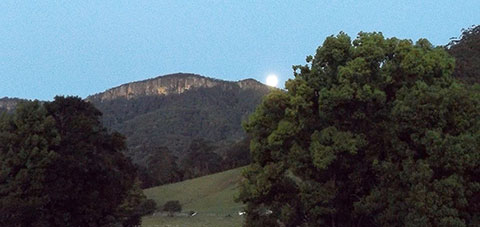
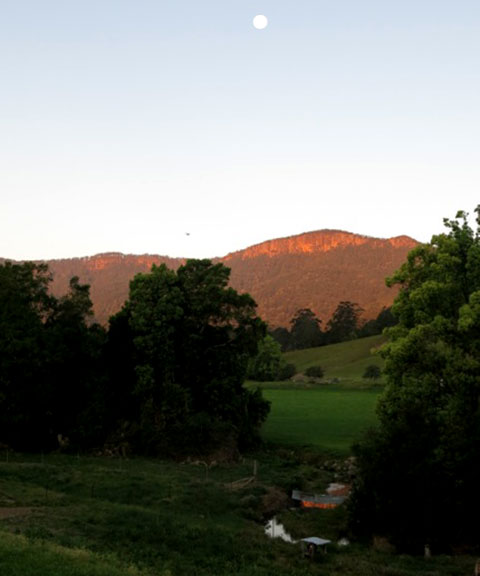
Or this moonrise, where the full moon looked for all the world like a celestial bowling ball rolling down the ridge…
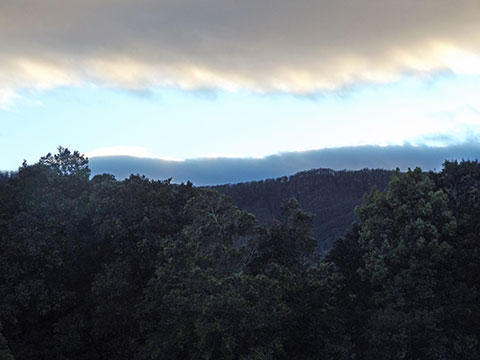
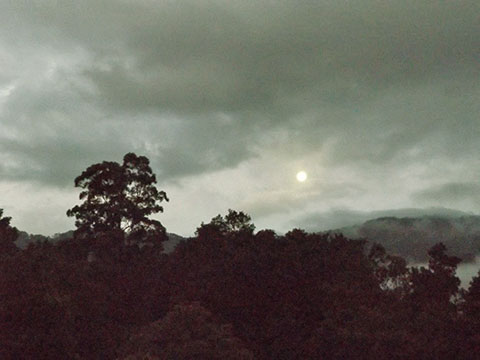
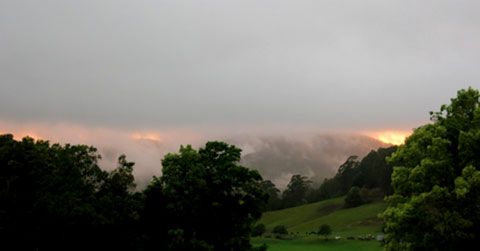
Or this early morning, where the upper grey cloud layer was moving quite fast to the north, while the lower dark one was pretending to be a further mountain range.
One of the reasons I just have to live near mountains is that they never look the same.
Sunlit or moonglowed, gaily golden, broodingly black or morning misted, their interaction with the sky and the light makes for a perpetually changing visual feast.
As at my old Mountain home, I can never decide which I prefer. But then, I don’t have to choose, because I can have them all!
I am probably irrevocably hooked on mountains and their moods.
The facing mountains are closer here than they were on my previous Mountain, but are similarly on my north-east, so also flaunt their moods most of a morning.
Their moods are partnered with the clouds descending from above and the mists drifting up from the valleys below, so between these three and the rising sun, the picture changes rapidly.
Yet evenings are differently eye-catching. The sun sets behind my ridge, but the escarpment opposite is higher and sees its last rays longer, while able to simultaneously profile an early moon.
The other evening it also gave me the first showing of the almost full moon.
I have moved mountains; it’s still strange here… but my link to these mountains is growing as I learn their moods.
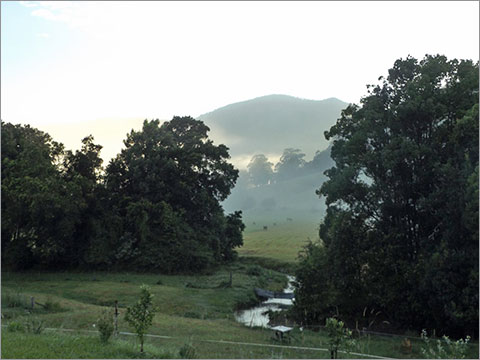
As you see, I have moved from what was my mountain and its range to a new set of mountains. This is what I woke up to the very first morning. So I (and you) can look forward to many good sunrises.
I am tucked into the side of the hill in this mountain-ringed narrow valley, with the little creek forming the border of my rural five acres.
It was a wet and soggy mountain I left and an even soggier hill I reached; four-wheel drive needed as I sank into the ‘lawn’.
As I get time to explore I will share my nature discoveries here… I am just waiting for the first snake. But already I know there are kooks, carolling magpies, crazy wattle birds and many small birds — and a pair of Welcome Swallows are nesting on the verandah just outside where I sit.
I can’t tell you for sure what the little birds are yet as I haven’t found my bird books; they’re in one of the dozens of boxes that tower teeteringly everywhere in here amidst the stranded furniture that I can’t think how to fit in.
How did I ever fit it all in before, in my little cabin? It looked so sadly sweet as I said goodbye after 36 years.
But good people have bought it and will love it and make it their own.
Of course a rural rather than a bush block brings a different set of challenges. Instead of conserving natural values, here I must replace them and rescue them from the onslaught of weeds, from fireweed, dock, wild ageratum and lantana to the ubiquitous Camphor Laurel trees.
If I thought I was moving to an easier life, I was temporarily deranged. When I am sorted out more here, and in between spending time at Gloucester to help them fight AGL’s CSG project in that beautiful valley — please visit the Gloucester Groundswell site.